I BUILT MY OWN CRM IN TWO DAYS AND IT CHANGED HOW I RUN MY STUDIO
Two years of adapting to tools that were never designed for how I work. Two days to build one that was.
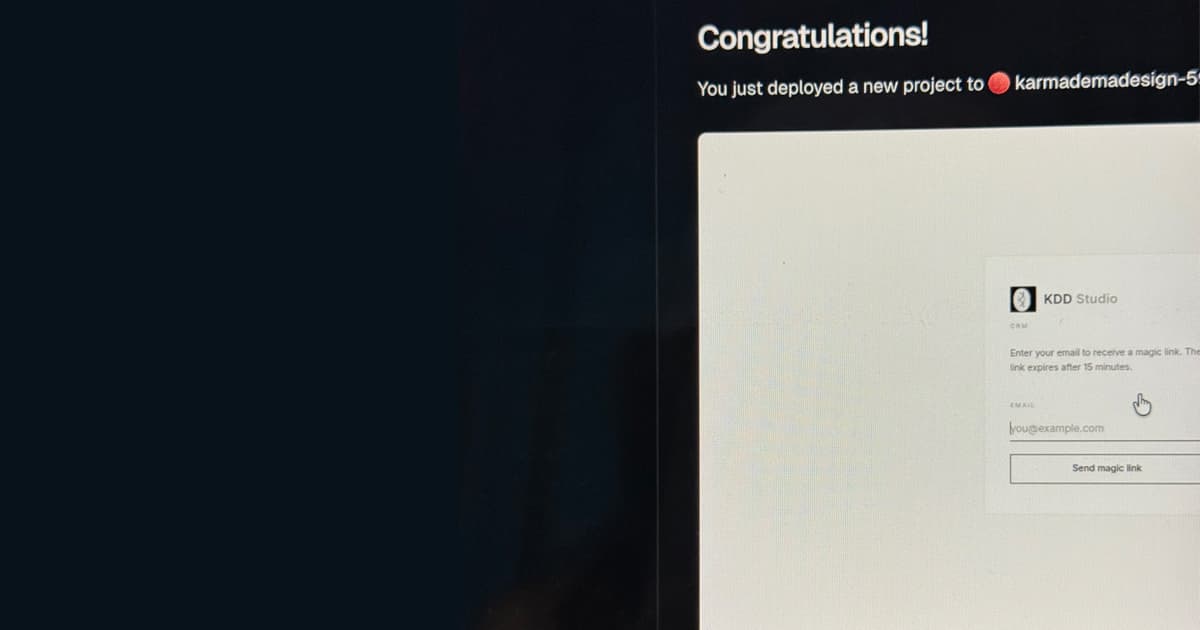
For two years, I avoided this.
Not building a CRM, but avoiding the decision to stop adapting my workflow to tools that were never designed for how I work.
I run KDD Studio. Branding, packaging, art direction, web. The kind of practice where every project lives in fragments. A DM thread, a folder of references, a half written proposal, an invoice waiting to be sent, a follow up I keep snoozing.
Standard creative studio chaos.
Acceptable at the start. Expensive over time.
I tried the usual answers. Notion. Airtable. HubSpot. Each one did 60% of what I needed and required 40% of my workflow in return. That trade never made sense.
So I built my own.
The System
In two days, I shipped a working CRM tailored to how I actually think and operate.
It includes:
Contacts. Every lead, client, and collaborator. Companies. Categorized and tiered A, B, C. Pipeline. Six stage opportunity tracking with weighted forecasting. Projects. Active work, deliverables, and status. Invoices. Sent, paid, overdue, auto flagged. Calendar view. Deal timelines and follow ups. Quick capture. Add a lead in seconds. AI daily brief. Priorities generated every morning. Lead scoring. 0 to 100 based on value, stage, and timing. Stuck deal detection. Flags inactive opportunities. Global search. Instant across everything.
All of it private. All of it intentional. All of it designed to remove friction, not introduce it.
What I Thought Would Be Hard
I expected the complexity to be technical. Database structure. Authentication. APIs. AI integration.
It was not. That part moved quickly.
What Was Actually Hard
The friction lived somewhere else, in the gap between "this should work" and "this works."
That gap is where most projects quietly die. Not big problems. Small, invisible ones.
The Newline That Broke Everything
At the end of the build, everything was ready. Deployed. Connected. Live.
I tried to log in. Error. Again. Error.
After twenty minutes, I found it. A hidden newline character in an API key. One invisible character that broke the entire authentication flow. The fix took seconds. Finding it did not.
That was the lesson. Systems do not fail where you expect. They fail where you are not looking.
Other Breakpoints
A few more moments that matter more than they should:
Account fragmentation. Different emails across tools. Nothing connected cleanly. Time lost untangling something avoidable.
Token exposure risk. A key nearly pushed to a public repo. Caught early, but a reminder that security is not optional.
Incorrect defaults. A platform misidentified the framework. One unchecked setting away from a broken deployment.
None of these are complex problems. All of them can stop momentum completely.
The Real Shift
This was not about building a CRM. It was about removing friction from how I operate.
Every missed follow up is lost revenue. Every scattered conversation is a broken system. Every delay compounds.
Now: every lead lives in one place. Every opportunity has a next step. Every project is visible. Every decision is faster.
No subscriptions. No external dependency shaping how I work. Just a system that matches how I think.
What I Run Now
Every morning at 7am, the system generates a daily brief. Three priorities. Pulled from real data, pipeline, deals, timelines.
Not productivity for the sake of it. Clarity.
Closing
Creative studios do not struggle because of a lack of ideas. They struggle because of fragmented systems. The architecture is rarely the real barrier. The follow through is.
If you are constantly adapting yourself to tools that do not fit your workflow, you are introducing friction into every part of your business. And friction, over time, is expensive.
Sometimes the better move is not to optimize what exists. It is to build what actually works.